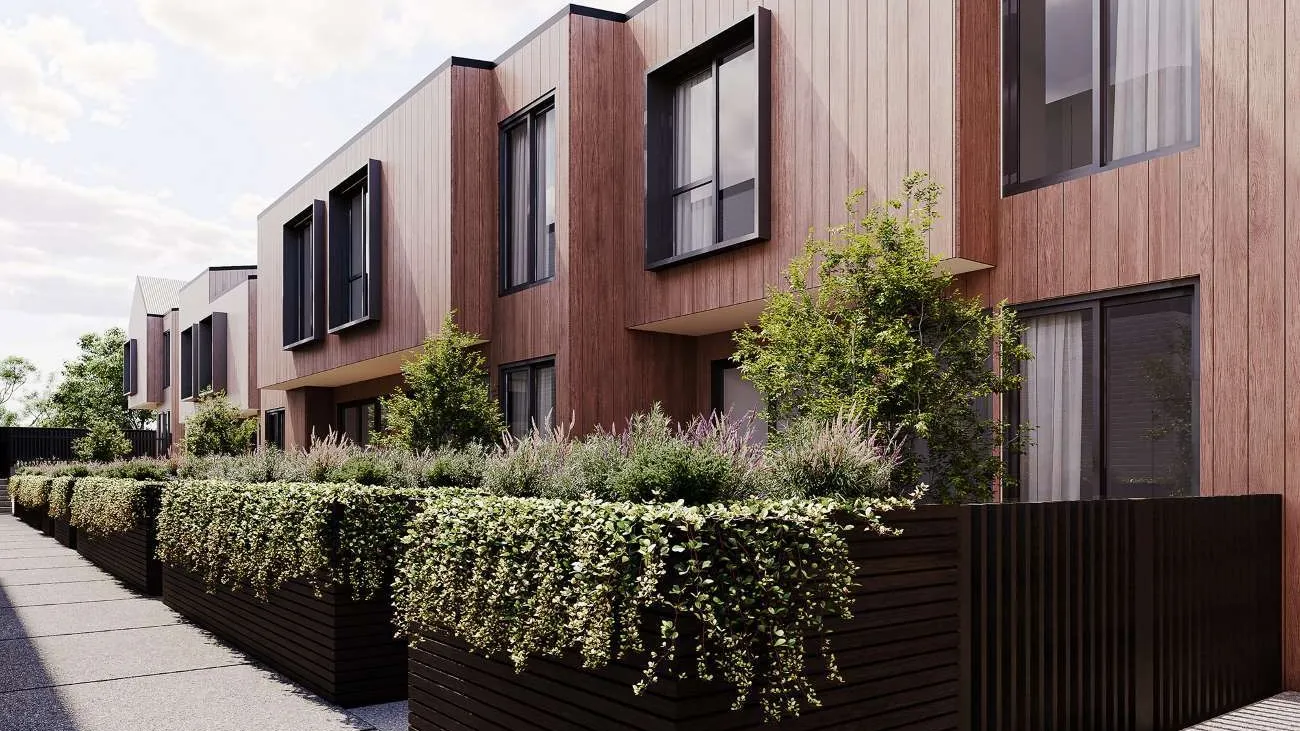
You have found a townhouse. Your own front door, your own courtyard, maybe stairs up to a bedroom with a view. It might not even share a wall with anyone. It looks like a house and it feels like a house.
If it is a unit title, legally it is closer to an apartment than to a house. That gap between how it looks and how it works is where buyers get caught, and it is why the decision on a unit title townhouse is often harder than people expect. This article walks through the calls buyers end up having to make.
It looks like a house. Legally, it isn’t.
Some townhouses sit in a row, sharing walls with the neighbours either side. Some stand on their own with a gap all the way round. It makes no difference to the legal position. If the property is a unit title, you own your unit and you are a member of the body corporate, along with every other owner in the development.
Being part of the body corporate means you share a lot more than a fence line. Typically you share:
- the building insurance for the development
- driveways, paths, gardens, rubbish areas and anything else that is common property
- the long-term maintenance plan, and the funds set aside for it
- the levies that pay for all of it
- the rules about what you can and can’t do
- the decisions made at body corporate meetings, including the ones you vote against
You pay for things you’ll never use
This is the part buyers find most counterintuitive. Your levies go towards the whole development, not just your unit. When a building at the far end of the complex needs a new roof, one you will never use, you may well be contributing. In a freehold house, your roof is your problem and nobody else’s. In a unit title, everyone’s roof is partly your problem.
What’s yours to fix isn’t always obvious
Who looks after a skylight, a deck membrane, a window or a heat pump on the outside wall? In a freehold house, the answer is always you. In a unit title, it depends on the unit plan, the body corporate rules and sometimes on what caused the problem. We regularly see body corporate managers answer these questions with “it may fall to the owner”. That is honest, but it is not an answer you can budget on.
Why unit title townhouses usually cost less than freehold
As a general rule, a unit title townhouse sells for less than a similar freehold house nearby. Buyers often see that as a good deal. It is better to see it as a price that already reflects what comes with it.
The price reflects the ongoing levies. It reflects the special levies that may come when big work is needed. It reflects that you share decisions about the building with other owners, and that you have less control over when and how money is spent. A lower price up front often means paying more over time.
None of this means a unit title townhouse is a bad buy. It means the decision is about more than the price.
The hard calls
These are the decisions we see buyers wrestle with during due diligence. Most of them do not have a clean answer.
Is the past work really finished?
Many complexes have been through remedial work, often for weathertightness. “Remediation is complete” can mean three different things:
- Practical completion certificate. From the project manager, under the building contract. The works are finished and owners are back in. The defects period and the contractor’s warranty usually run from here.
- Code compliance certificate. From the council. It confirms the work complies with the building consent. This is the one your bank and your future buyer care about.
- Final completion certificate. From the project manager, at the end of the defects period.
A vendor can say “all done” and mean only the first. Ask for all three. Then ask about warranties. If the paperwork predates the current body corporate manager, you may be told they cannot confirm whether a warranty exists at all.
What will it cost next?
One year’s levy figure tells you very little. Read three years of accounts and AGM minutes, and the last 12 months of committee minutes. Look for:
- what is actually in the maintenance and contingency funds
- special levies, borrowing and the interest on it
- whether the long-term maintenance plan is up to date, or overdue for review
- any legal claim the body corporate is running, and what it may cost owners
- the next big item, like a repaint or a roof, and whether anything is saved for it
Timing matters. A special levy made after you settle is yours to pay, even if the work was done before you bought. And if a past special levy came in under budget, the refund may go to the owner who paid it, which is the seller, not you.
What do you ask the vendor to fix?
Your building report will pick up issues inside the unit, like a bathroom with moisture readings or a fan that doesn’t work. Those are fair to raise with the vendor. It may also find problems with the roof or cladding. Those are usually the body corporate’s to deal with, not the vendor’s, so the most you can ask is that the vendor reports them to the body corporate.
If the vendor offers money rather than repairs, decide whether you want a price reduction or a credit at settlement. Either way, tell your bank. Lenders lend against the price, and they will want to know about anything that changes what you are really paying.
Can you make the changes you want?
Planning to add a heat pump, an awning or a new deck? In a freehold house that is between you and the council. In a unit title, changes to the outside usually need body corporate approval under its rules. You can ask before you buy, but expect the answer to be that it will be considered when you apply. Nobody will approve it in advance.
The same goes for what is happening around you. If there are commercial units in the development, or units being used differently from how they were built, the body corporate will often say that’s a question for the council or the occupiers.
Is a promise enough?
If due diligence turns up a cost that might land after you buy, you can ask the vendor to cover it. There are two ways to do that. A retention is money held back from the price in a lawyer’s trust account until the cost is known. An indemnity is the vendor’s promise to pay if it happens. Vendors much prefer the second.

Do you need more time?
Ten working days is rarely enough to read a full body corporate disclosure pack properly. Documents arrive late and the minutes you most need are the ones nobody sent. Negotiate a longer period at the start, if you can.
If you need an extension, watch the wording. A vendor may agree to extend “only for that one issue, on the basis that due diligence is otherwise satisfied”. That quietly gives up your right to walk away for any other reason. Ask for the whole condition to be extended.
Due diligence is the decision point
Once you confirm due diligence, what you found in the body corporate records is no longer a way out. Finance is not a second chance either. Under the standard agreement, the party a condition is for has to do all things reasonably necessary to fulfil it, so a finance condition only protects you if the bank genuinely will not lend.
That is what makes this decision hard. You are weighing risks that may never happen against a property you like, with some questions that nobody can answer, and a deadline. Your family will have views. Your broker will have views. In the end it is your call.
The hard part isn’t finding the answers. It’s deciding what to do when some of the answers don’t exist.
Walking away is a legitimate outcome. It is exactly what the due diligence condition is there for. Sometimes a vendor comes back after a cancellation with the terms the buyer asked for in the first place. You should not count on it, but in a buyer’s market it does happen.
Our buying property team can work through these decisions with you before you commit.
Before you go unconditional
Ready to take the next step? If you are looking at a townhouse in a unit title development, get the agreement and the disclosure pack to your lawyer early, ideally before you sign. Contact NZ Legal to get started. Fill out our quick contact form and we’ll be in touch within one business day.
Hero image: architectural render of the Newmarket Quarter townhouses, Auckland, as published by OneRoof.
Sources
- Unit Titles Act 2010, ss 146 and 147The disclosure statement and the pre-settlement disclosure statement referred to in the article and checklist.
- ADLS/REINZ Agreement for Sale and Purchase of Real Estate, 11th edition 2022, cl 9.10(2)The party a condition is for must do all things reasonably necessary to fulfil it.
- Unit Titles Act 2010, levy provisions (s 121 and related)A special levy made after you settle is yours to pay, even if the work was done before you bought.
- Building Act 2004, code compliance certificate (s 95 and s 7 definition)A code compliance certificate is issued by the council and confirms the work complies with the building consent.
Was this article useful?
Thanks for the feedback. It helps us improve.